
The Inevitable Maverick
Time has come and gone for Republican voters to cast their ballots for their favorite presidential candidates, and John McCain appears to be the inevitable nominee. In order to win the presidency, "The Maverick" must win back his credibility with the conservative base.
John McCain has lived an honorable life, and his life story should serve as an inspiration to every American, right, left, and center.
One small problem, many conservatives say: he's not Ronald Reagan. Every "Reagan-or-else" conservative who stayed home is getting what they deserve for doing so. They had their chance. Had they supported Fred Thompson or Mitt Romney, they would find themselves in a better position. These self-declared hardcore conservatives who will vote for McCain will do so reluctantly in 2008, and he must prove his leadership during his first term, or he will be starved at the polls in 2012.
As of now, many conservatives believe that by sitting out in 2008, history will repeat itself as it was in the days of Jimmy Carter if either Hillary Clinton or Barack Obama are to take over the White House. This is a childish assumption of economic ruin to a dystopian proportion. To make matters worse, they fail to see that it took much more than Jimmy Carter to give us Ronald Reagan. Gerald Ford and Richard Nixon were perhaps the weakest Republican presidents in the late 20th century, whose policies offered little recovery from Lyndon Johnson's disasterous "War on Poverty." Even by 1976, the GOP wasn't ready for Ronald Reagan, and the struggle for economic freedom had begun shortly after the Kennedy assassination.
John McCain is not a "liberal." His platform is compatible with the basic tenets of conservatism, and are the mere party line of Thatcher's modern-day Conservative Party in Great Britain.
While John McCain and mainline conservatives have many substantive disagreements, his McCain's positives by far outweigh his negatives. He appears to be open, honest, and sincere about his positions and intentions. If conservatives are strong and firm enough in their areas of agreement with McCain, they will support him on key issues, such as terror, taxes, and judges.
Still considering a third party vote?
If you did not like Ron Paul, you will not like the third party alternatives. There is no clear and fundamental difference between Ron Paul, the Constitution Party, and the Libertarian Party on the issues of foreign policy and homeland security. Both want immediate withdrawl from Iraq and removal of a long list of Bush's anti-terror policies with no suggestions for alternatives.
The Constitution Party is strictly non-intervention, uncompromising on gay rights (they've even taken shots at James Dobson), as absolutist as they come on abortion, in favor of protectionist trade policy, and silent on the War on Terror.
The Libertarian Party is Ron Paul on steroids. They only seem to view policy issues through an economic lense, which can be defined as anarcho-capitalist in their general worldview. That might explain why they support unfettered abortion rights, homosexual marriage, legalized prostitution, state-sponsored gambling, recreational drug use, and open borders. These policies are further to the left than the vast majority of the Democratic Party claims to be, although they may appeal to Ruth Bader Ginsburg.
Although John McCain has not been known to market religion in the Senate, he understands the culture war between secular progressives and traditionalists. He has made a tireless effort to make amends with religious voters and should be forgiven for his past transgressions against Jerry Falwell and the religious right. The last thing even a conservative should expect to see is John McCain appointing an activist judge like Ruth Bader Ginsburg.
John McCain has been unwavering in the War on Terror, and the success of the troop surge is largely due to his leadership, attentiveness, and commanding capabilities. He's had the most military credentials out of any candidate who participated in the race. His campaign has focused on a sympathetic approach to the needs of veterans, past and present.
Many conservatives would concede these points, but point out that he is a staunch opponent of waterboarding. Waterboarding may be an overrated tactic, and the GOP should respect McCain's moral opposition - as a former POW himself - if he can propose a viable alternative.
On economic issues, McCain has given up largely on class warfare and has pledged to continue his efforts to make the Bush tax cuts permanent. He opposed the 2001 and 2003 Bush tax cuts initially, but it's conceivable to believe that he has changed his position upon witnessing the creation of millions of new jobs and companies expanding their businesses in the States. In addition to the tax cuts, McCain has exhibited the principle of fiscal restraint in Congress, as opposed to many big-spending "neoconservatives" in the Senate.
The issue of illegal immigration is most controversial of all. At his recent speech at the CPAC convention, many conservatives in the audience booed his very mentioning of the topic. He responded by pledging to secure the border before opening the debate on a path to citizenship. Should he become president, his feet will be held to the fire by border advocates who are fed up with President Bush's self-centered approach to the issue. Conservatives should not rule out McCain's promise to improve border security so quickly. He is aware of the growing concern over the issue, especially after the massive protest following "McCain-Kennedy." Neither Obama or Clinton would be forced to hear their base out on the issue, and have no political incentive to do so. Instead, they have every incentive to pander to voters, illegally or not.
What this election will come down to is the differences that remain between McCain and the Democratic nominee.
The Democrats have made a huge mistake by backing inexperienced, divisive, and far-left candidates who represent a congressional majority with an embarrassing 11% public approval rating. This Congress, led by Harry Reid and Nancy Pelosi, was not given the majority vote to retreat from Iraq, but to change course and enact a more promising strategy. Clinton and Obama have the same far-left positions on moral issues and national defense that gave John Kerry a humiliating defeat in 2004. Voters don't want to hear about "change" for the sake of change. They want to know how the candidates would leave the White House better than they found it.
Showing posts with label military. Show all posts
Showing posts with label military. Show all posts
Friday, February 08, 2008

Saturday, June 02, 2007
A Better Vision For Iraq
There are those who believe in peace through strength. And there are those who seem to believe in peace through wishful thinking.
Given that vision is not necessarily a virtue, the Bush Doctrine tends to reside on the latter. Indeed, vision can be a scary thing. Many of the most successful presidencies were made so because they were not led by men who saught to leave behind a legacy. George H.W. Bush struck Saddam down when time made it right. His son, on the other hand, seemed to waste little time in drafting the case against the man who tried to kill his father.
After the plot had been arranged to take over the Ba'ath Party in Iraq, a confident President Bush made his way out to the United Nations in search for allies in his next phase in the "War on Terror." Bush charged Saddam for having violated sixteen United Nations Security Council Resolutions repeatedly. Oddly enough, the UN had no will to enforce their own resolutions. France and Russia were quick to reject the proposal to go to war, although their intelligence both suggested that Saddam was in pursuit of WMDs. Obviously, Saddam was quite brotherly as a trading partner to those nations.
In a 2003 interview with Newsweek, George Herbert Walker Bush discussed the seemingly enormous hassle of getting support from the French government, even during Saddam's invasion of Kuwait.
MEACHAM: Do you regret that the president was unable to build the kind of international coalition you had in 1990-91?BUSH: It’s a very different problem he faces, and my coalition-building was far easier because you could see the troops from Iraq in Kuwait. Even then, though, there was a lot of opposition. I was reminded by one of my top people the other day that the French were very difficult to get onboard.
What burns me up now are these statements that are critical of the president and of Colin Powell—"failed diplomacy." The problem they face is so different and so much bigger that I think any comparison is just night and day. It seems to be au courant, if you’ll excuse my knowledge of French, having studied it for 11 years, but I don’t agree with it. I think when history is written people are going to find some very interesting things about the French position. And I’m annoyed at the German position. I don’t talk about it publicly, but I know a lot of German people not in the coalition government with Schroder who are very, very upset about the position of their government.
MEACHAM: What do you think is going on with France?
BUSH: [Pause] They’re French.
MEACHAM: Any elaboration?
BUSH: Nope. There’s always been some friction. I was once talking to a group of French intellectuals, and I said, “You think we’re arrogant, and we think you’re French.” And they looked at each other and thought maybe I’d said something very intelligent. But that may well be it. It’s too bad, but life goes on, and we’ve got to do what we’ve got to do.
In Bush's declaration of war, he was clear to market the intervention with the language of a compassionate crusader. Mistakes would soon follow: Defense Secretary Donald Rumsfeld insisted to carry on in his military buildup of expanding technology rather than reach a definitive strategy with a substantial amount of ground forces - a mistake that was foreshadowed by the hunt for Osama bin Laden in Afghanistan. All things considered, the US miltary and its allies were quick to topple an oppressive regime and achieved a series of early successes.
Then came the downfall of the Bush Doctrine.
Iraq somehow went from a potential terrorist threat to a democracy project, which created a time-consuming, bottomless pit expense. To this day, much of the developments in Iraq are being done by the military, when the Iraqis can take many tasks upon their own hands. In retrospect, the invasion would have been victorious in the long run if we had conducted a broad-scale search for illegal weapons, caught Saddam, and demanded that he pay financially in return for his failure to comply with the UNSCRs.
Needless to say, we might as well have declared victory in Iraq four years ago with these recommendations. We didn't have to make Saddam's Iranian problem our own problem. Instead, thousands upon thousands of needless civilian and military deaths came as a result of insurgent attacks - with credible evidence suggesting that the Iranians are behind many of them. A shorter stay would mean less deaths and better relationships with our allies.
Although we have brought life to a new democracy at an extremely high cost, there is still hope for more success in Iraq. Not all hope is lost.
Since the troop surge, sectarian violence and insurgent attacks have reportedly dropped on a dramatic scale. Patrick Ruffini of Townhall.com had a hopeful column two weeks since the surge began. Even though there have been successes in the Baghdad area, cynics warn of the consequences of spreading our military too thin, too late. Take for example, the fact that amputee soldiers are being sent for yet another tour of duty in Iraq.
As arrogant as the Democratic Congress has positioned itself, they managed to pass a $120 billion bill to fund the war without the danger of the timetable included.
After struggling for months to persuade Congress to issue a clean bill to fund the war, President Bush must use it wisely. The best option would be to bulk up on the surge for another 4-6 months and invest the remainder into Iraq's military, and lead our way out of Iraq from there.
A new and democratic government in Iraq may undergo many struggles on its own to win the peace, but the sooner we give them complete sovereignty of their own country, the sooner the Iraqis can prevail. Iraq can be a godsend as a trading partner to the free world, and more peace and national unity will come about as a result.
Friday, April 13, 2007
What Would a Centrist Platform Look Like?
I figured I'd find out.
So here, we've rounded up half a dozen party outcasts - Tim Roemer, Rudy Giuliani, John McCain, Ben Nelson, Joe Lieberman, and Arlen Specter. Their worldviews have astounding similarities - strong support for tax cuts, health coverage, free trade, capital punishment, and military spending - among other general agreements.
Strikingly similar to our last Republican-led Congress: favorable to tax cuts, but otherwise heavy on spending and government, socially moderate, and pro-military. Overall, aligned with the majority of Americans.

Click on the pictures to enlarge.
Personal Issues:
Favorable to:

I figured I'd find out.
So here, we've rounded up half a dozen party outcasts - Tim Roemer, Rudy Giuliani, John McCain, Ben Nelson, Joe Lieberman, and Arlen Specter. Their worldviews have astounding similarities - strong support for tax cuts, health coverage, free trade, capital punishment, and military spending - among other general agreements.

On The Issues is a generally reliable source of information, although their dichotomy is a little faulty. My previous "mass project" had more thorough analysis on political philosophies. In any event, I took into account all the major positions of the Selected Six, and used the dominant outcome to determine the "party line."
In taking the PoliticsMatch Quiz, I answered according to the platform. The results were interesting. Here is the graph of the party line.
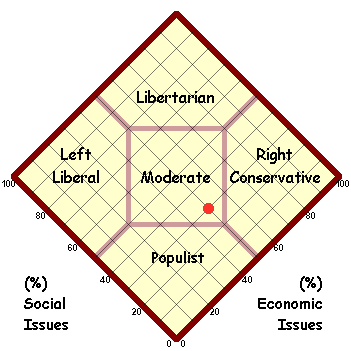
Strikingly similar to our last Republican-led Congress: favorable to tax cuts, but otherwise heavy on spending and government, socially moderate, and pro-military. Overall, aligned with the majority of Americans.
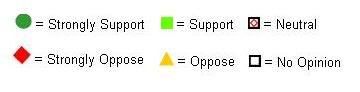
Click on the pictures to enlarge.
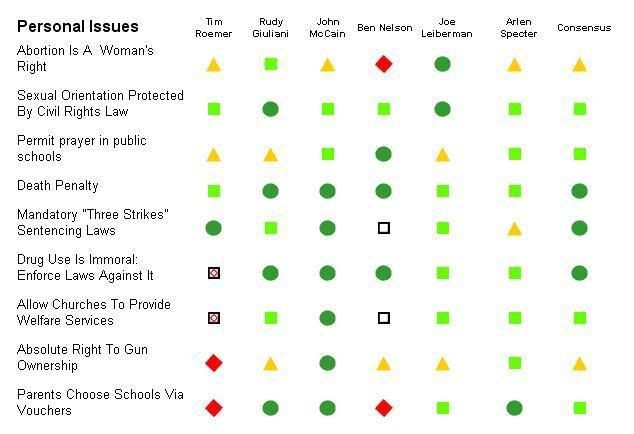
Personal Issues:
Favorable to:
- Sexual Orientation Protected by Civil Rights Law
- School Prayer
- Capital Punishment
- "Three Strikes" Sentencing Laws
- Anti-drug Legislation
- Allowing Churches to Provide Welfare Services
- Educational Choice
Opposed to:
- Abortion as a Woman's Right
- Absolute Right to Gun Ownership
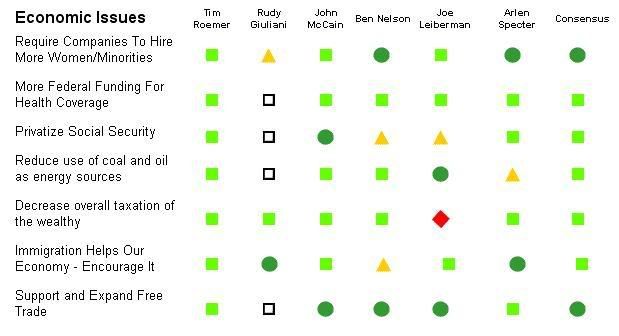
Favorable to:
- Affirmative Action
- More Federal Health Coverage
- Privatized Social Security
- Reducing Use of Coal and Oil
- Tax Cuts
- Immigration
- Expanding Free Trade
Opposed to:
- Non-Applicable
Military Issues
Favorable to:
- More Spending On Armed Forces
Opposed to:
- Seeking UN Approval for Military Action

Monday, April 02, 2007
I Accept This Rudy For All His Faults
There's plenty to be said about America's Mayor, and given his current popularity, much will be said. Given his diversified worldview, few disagree that there is a Rudy for everyone.
Because this presidential election will ultimately make way for America's path in the War on Terror, there may never be a better time for Rudy Giuliani to receive the nomination. The Democrats are likely to champion the "anti-war" position - no protection under the Patriot Act, immediate retreat from Iraq - while Giuliani remains a consistent but civil advocate for getting the job done at home and abroad. While many conservatives find him weak on domestic policies, few can deny that he has the necessary will to protect all Americans, whether serving in the military, or living amongst the civilian population.
The Democrats' biggest problem: when Americans think of 9/11, they think of Rudy Giuliani.
He dealt with the issue firsthand, and his leadership and charisma were vital in restoring not only New Yorkers, but America's ability to get on with their lives. As of now, no contending Democrat has a public image of confidence and security that Giuliani has. The same can be said just as easily about Giuliani's Republican contenders.
As of yet, there is no Republican candidate who can compete with Rudy Giuliani on the most important issue of our time - Radical Islam. While he masterminded the troop surge in Iraq, Arizona's Senator John McCain has lost credibility with conservative voters on many domestic policies. Although to the contrary, Mitt Romney, the Governor of Massachussetts, has morphed into a solid conservative over the last few years, he has established himself as a flip-flopper in doing so. Senator Sam Brownback of Kansas is a strong social conservative, but he is weak on border security. While I leave many second tier candidates unnamed, I have my reasons: they won't get the nomination. The only potential and viable alternative to Rudy Giuliani at this point is former Senator Fred Thompson, and he might not even run for office.
Indeed, Giuliani's resume as Mayor of New York City is impressive for many Americans. Prior to Mayor, he served as Associate Attorney General under Ronald Reagan in 1981. In 1983, he became United States Attorney for the Southern District of New York. Under Giuliani as Mayor, overall crime decreased by 56%, and murder by 66%, making New York City the safest large city in the country according to the FBI. Not a bad record for a nation that is weary of crime and terrorism, both foreign and domestic.
His economic performance was met with the same successes. When Giuliani first took office, one in seven New Yorkers were on welfare. Welfare rolls were reduced by 60% as a result of a welfare-to-work initiative, or "workfare," for buzzword's sake. In addition, 23 city taxes were either reduced or eliminated, turning a $2.3 billion budget deficit into an enormous surplus. As a result, 423,000 private sector jobs were created in his two terms as Mayor, and tourism grew to an all-time high.
In response to his leadership, Giuliani has won enormous praise from former presidential candidate Steve Forbes, now serving as Senior Policy Advisor for Giuliani's campaign. In an op-ed from the Wall Street Journal, Forbes writes:
"He set out to restore fiscal discipline to the 'ungovernable city' – and achieved results that Reagan Republicans can applaud."
Rudy has also received praise from columnist George F. Will, who has criticized the Bush Administration as too optimistic about the War in Iraq. He says of Giuliani:
"His eight years as mayor of New York were the most successful episode of conservative governance in this country in the last 50 years."Other endorsements include neolibertarian comedian and talk show host Dennis Miller, Michigan state Rep. Jack Brandenburg, and former U.S. ambassador to the Bahamas Richard Blankenship.
Rudy's biggest problem: his ornery conservative base. While many applaud his accomplishments as Mayor of New York City, as well as his contagious tranquility on 9/11, the domestic issues have hurt Giuliani the most. He supports legalized abortion, although he now oppposes partial-birth abortion. He has praised both John Roberts and Samuel Alito of the Supreme Court...
"I think the appointment of judges that I would make would be very similar to if not exactly the same as the last two judges that were appointed. Chief Justice Roberts is somebody I work with, somebody I admire. Justice Alito, someone I knew when he was US attorney, also admire. If I had been president over the last four years, I can't think of any-- that I'd do anything different with that."...while delivering a bothersome complement for the radical ex-ACLU General Counsel turned Supreme Court Justice Ruth Bader Ginsburg:
"And what's important to me is to have a very intelligent, very honest, very good lawyer on the court. And [John Roberts] fits that category, in the same way Justice Ginsburg fit that category. I mean, she was -- she maybe came at it from a very different political background, very qualified lawyer, very smart person."
Other criticisms include gun control, illegal immigration, and a "Kerry-esque" stance on homosexuality. Yet in spite of a handful of liberal positions, Giuliani is most loathed for attending a Gay Pride event in drag. However, if he manages to keep his Dukakis moments to a minimum, he will maintain his popularity as America's Mayor, rather than the "Drag Queen of New York."
Social conservatives find these domestic policies comparable to Bill Clinton. They are also comparable to Barry Goldwater and Margaret Thatcher, who both advocated expanded rights for homosexuals and legalized abortion. Yet today, many conservatives continue to revive them as heroes who stood up to their enemies, as well as the establishment, in times of great moral conflict.
Social conservatism will be remembered for 2004, when "moral values" defined the re-election of President Bush, in spite of harsh criticism for the Iraq War. Predictably, the social conservative movement has since lost ground, as Congress was soft on the positions that mattered most to the American public. Consider the mid-term elections in 2006.
The Grand Old Party made every effort to repeat its prior successes with a brilliantly crafted catchphrase: "San Francisco Values." Considering the indictments leading up to the election, real (Mark Foley) or fake (Tom DeLay), even the most religious voters weren't swayed into voting straight GOP. It didn't matter that William Jefferson had nearly $100,000 found in his freezer, or that Harry Reid accepted illegal bribes from the boxing industry, because the GOP did not fight back. Now, we have Speaker Pelosi, and we don't know what to do with her.
Domestic issues aside, neither Rudy's Republican or Democratic opponents can compete with the leadership we saw on 9/11. Rudy Giuliani has the charisma to unite America that his contenders lack. Barack Obama has a sense of civility, but his lack of experience in any given area will be difficult to overcome. Hillary Clinton is effortlessly exposable as a partisan panderer. John Edwards hasn't reinvented himself, and is still obsessed with "The Two Americas."
While "San Francisco Values" was a slick cliche for a while, it has been worn out to exhaustion. It's time to mature as American citizens and focus on the number one issue of our time. The Presidential Election of 2008 will remain crucial, and our direction in the War on Terror will be determined once and for all.
Thursday, March 22, 2007
Civility No More: The Art of a Freakshow
Portland, Oregan
Population: 529,121
Portland, Oregan. Where the sun is shiny, the ice is slippery, and everyone is stoked to see the president. Well, unless it's August 22, 2002, the day that the Portland chapter of the Pacific Green Party went out of their way as they joined circles to turn a Bush speech into a hatemongering convention. And no, I don't refer to the conservative minority as the hatemongers. As it became evident that the protesters would not keep their cool, the police declared a state of emergency on the rowdy crowd of Bush-haters. As the protesters refused to pipe down, the police were forced to fight back. One victim of pepper spray was a ten-month old baby. That's right. Someone had the nerve to bring a young infant to a radical left-wing frenzy. Luckily, the child was okay. But let this story be a warning to those who insist on protesting: find a sitter. When police officers are threatened, they will strike back. I know, how brutal.
On March 18 of this year, they were at it again. While some left-wing blogs have insisted that the protests were peaceful, they are leaving an audience misguided. According to police spokesman Brian Schmautz, there were "a number of items thrown at our officers over the past few hours." According to Fox News, "Supporters of Bush... were jostled and taunted by protesters as they arrived for a fund-raiser."
Let's take a look at what the evil hoodwinkers at Fox decided not to show you.

My parents put me through tougher interrogations than the enemy combatants at Gitmo have been through. And no, they didn't give me La-Z-Boys and pastries to even the score. Knowing how evil the U.S. government is, they had to dramatize every case of fleas they conspired.

Although these Portlanders mix too much Chomsky in their marijuana, you gotta give them credit where credit is due: at least they aren't hypocrites when it comes to supporting American troops.

After years of book burnings, the ninjas wanted revenge. So they burned our flag.

Okay, I admit it. We have free enterprise in this country.
______________________________________________________________________________
Let's see if San Francisco's protest, held on the same day, was any better.
San Francisco, California
Population: 776,733
I think we're dreaming. After all, this is the city where a protester fell off a bridge at the beginning of the war.


Portland, Oregan
Population: 529,121
Portland, Oregan. Where the sun is shiny, the ice is slippery, and everyone is stoked to see the president. Well, unless it's August 22, 2002, the day that the Portland chapter of the Pacific Green Party went out of their way as they joined circles to turn a Bush speech into a hatemongering convention. And no, I don't refer to the conservative minority as the hatemongers. As it became evident that the protesters would not keep their cool, the police declared a state of emergency on the rowdy crowd of Bush-haters. As the protesters refused to pipe down, the police were forced to fight back. One victim of pepper spray was a ten-month old baby. That's right. Someone had the nerve to bring a young infant to a radical left-wing frenzy. Luckily, the child was okay. But let this story be a warning to those who insist on protesting: find a sitter. When police officers are threatened, they will strike back. I know, how brutal.
On March 18 of this year, they were at it again. While some left-wing blogs have insisted that the protests were peaceful, they are leaving an audience misguided. According to police spokesman Brian Schmautz, there were "a number of items thrown at our officers over the past few hours." According to Fox News, "Supporters of Bush... were jostled and taunted by protesters as they arrived for a fund-raiser."
Let's take a look at what the evil hoodwinkers at Fox decided not to show you.

My parents put me through tougher interrogations than the enemy combatants at Gitmo have been through. And no, they didn't give me La-Z-Boys and pastries to even the score. Knowing how evil the U.S. government is, they had to dramatize every case of fleas they conspired.

Although these Portlanders mix too much Chomsky in their marijuana, you gotta give them credit where credit is due: at least they aren't hypocrites when it comes to supporting American troops.

After years of book burnings, the ninjas wanted revenge. So they burned our flag.

Okay, I admit it. We have free enterprise in this country.
______________________________________________________________________________
Let's see if San Francisco's protest, held on the same day, was any better.
San Francisco, California
Population: 776,733
I think we're dreaming. After all, this is the city where a protester fell off a bridge at the beginning of the war.
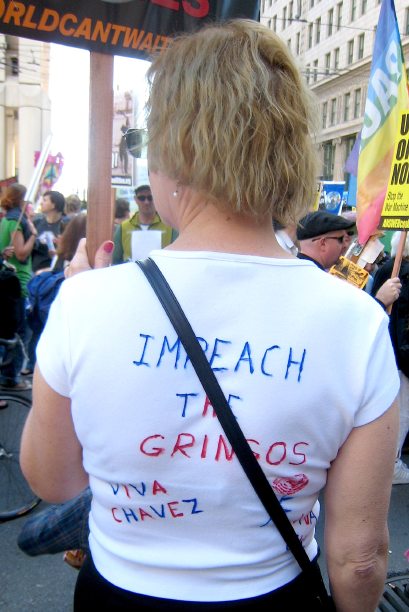
Look at this worthy cause. Let's trade in Bush - or any gringo for that matter - for a dirty socialist like Hugo Chavez.

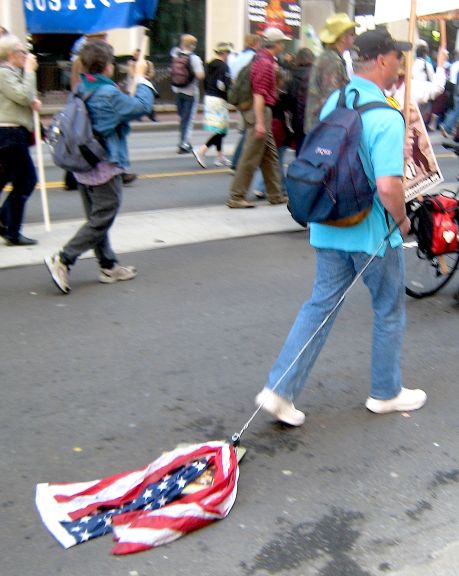
Umm, Sir, that flag isn't gonna hold itself up.

Given their track record, this man could be hired to teach at Kent State University.
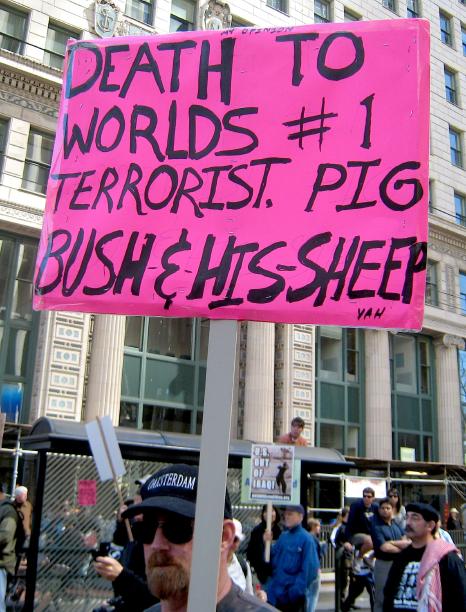
The animal rights crowd might not take too kindly to this one.
Wednesday, January 10, 2007
Cokehead Comedian Party Officially Takes Over Congress
As you can tell, I haven't got around to adding much of anything on Social Surgery for a while. In part, this is because my new job has given me very little free time, and also, because I've grown tired of what it has become.
As the title may suggest, I, your doctor, will no longer prescribe my patients with sugar to make the medicine go down. You will enjoy shock therapy a lot more. If you grow weary of my disregard for the Fairness Doctrine, you can always check out Bill O'Reilly's No Spine Zone. After all, results may vary.
So how about that Cokehead Comedian Party?
On the first day as Speaker of the House, Nancy Pelosi managed to turn Congress into a day care center, proclaiming that this Congress will be "about the children." If she is implying rights for children to abort each other, then I certainly see her point.
Unless of course she referred to the other way the Democrats have been known to use hangers - by collectivization of wealth in exchange for an explosion of welfare programs that produce the exact opposite of its stated intentions, creating a lazy society of deadbeats that leech off anyone who makes an honest living. Already, there have been talks of tax hikes before the “first hundred hours” of the Great Leap Forward.
So it may help if I give you some history behind the “first hundred hours.” The term is a reference to a promise Franklin Roosevelt made to combat the Great Depression during his “first hundred days” as president. Little were you taught, FDR went on to fight unemployment like none other – by primarily drafting the unemployed into World War II.
After giving us a masculine bicep flex, the Wicked Witch of the West went on to further recognize the “arrogant white male” with a sinister comment about going “from the kitchen to Congress.” Anyone who knows the difference between Nancy Pelosi and apple pie knows all too well that she has lived a privileged life from the get-go. She was born into a political family, as the daughter and sister of mayors in Baltimore.
The congressional circus is expected to be followed by tampering with a robust economy with a massive minimum wage hike, and more importantly, blockage of a much-needed troop increase in Iraq. The sheeple may not have voted for cut and run, but a more effective strategy in Iraq. Sadly, it looks as though cut and run is not “off the table.”
As the president prepares to unveil his new plan for Iraq, he should expect plenty of resistance from the defeatists. Joe Biden and Harry Reid have predictably rushed to judgement against a troop increase. Why, you ask? Because they want to lose the war. But rather than show their true colors, they hide behind such decorated slogans as “phased redeployment”
In other words, put down your guns and surrender, but only after enough American troops get killed.
As you can tell, I haven't got around to adding much of anything on Social Surgery for a while. In part, this is because my new job has given me very little free time, and also, because I've grown tired of what it has become.
As the title may suggest, I, your doctor, will no longer prescribe my patients with sugar to make the medicine go down. You will enjoy shock therapy a lot more. If you grow weary of my disregard for the Fairness Doctrine, you can always check out Bill O'Reilly's No Spine Zone. After all, results may vary.
So how about that Cokehead Comedian Party?
On the first day as Speaker of the House, Nancy Pelosi managed to turn Congress into a day care center, proclaiming that this Congress will be "about the children." If she is implying rights for children to abort each other, then I certainly see her point.
Unless of course she referred to the other way the Democrats have been known to use hangers - by collectivization of wealth in exchange for an explosion of welfare programs that produce the exact opposite of its stated intentions, creating a lazy society of deadbeats that leech off anyone who makes an honest living. Already, there have been talks of tax hikes before the “first hundred hours” of the Great Leap Forward.
So it may help if I give you some history behind the “first hundred hours.” The term is a reference to a promise Franklin Roosevelt made to combat the Great Depression during his “first hundred days” as president. Little were you taught, FDR went on to fight unemployment like none other – by primarily drafting the unemployed into World War II.
After giving us a masculine bicep flex, the Wicked Witch of the West went on to further recognize the “arrogant white male” with a sinister comment about going “from the kitchen to Congress.” Anyone who knows the difference between Nancy Pelosi and apple pie knows all too well that she has lived a privileged life from the get-go. She was born into a political family, as the daughter and sister of mayors in Baltimore.
The congressional circus is expected to be followed by tampering with a robust economy with a massive minimum wage hike, and more importantly, blockage of a much-needed troop increase in Iraq. The sheeple may not have voted for cut and run, but a more effective strategy in Iraq. Sadly, it looks as though cut and run is not “off the table.”
As the president prepares to unveil his new plan for Iraq, he should expect plenty of resistance from the defeatists. Joe Biden and Harry Reid have predictably rushed to judgement against a troop increase. Why, you ask? Because they want to lose the war. But rather than show their true colors, they hide behind such decorated slogans as “phased redeployment”
In other words, put down your guns and surrender, but only after enough American troops get killed.
Thursday, November 09, 2006
Democrats Take Over the House
Nancy Pelosi is now the Speaker of the House. Secretary Rumsfeld has resigned. And the Democrats are celebrating.
Pelosi has promised to put ethics and bipartisanship ahead of everything. She has also stated that immediate withdrawal and impeachment are “off the table.” The Democrats have been meeting with President Bush to set the new course for Iraq. And that’s really all you need to know.
Why did the Republican Party lose?
Instead of advocating moral values, they were convicted of scandals. Rather than practicing fiscal restraint, they built a bridge to nowhere. Instead of fighting crime, they supported amnesty for illegal aliens. Most notably, instead of staying the course in Iraq, President Bush had suggested that we need a new plan. That’s why conservatives stayed home.
Libertarian voters have been frustrated with the expansion of government on socio-economic policy, whether it was the Gravina Island Bridge, prescription drugs for seniors, or the expansion of homeland security that apparently harms our civil liberties. While the Bush Administration has been relatively soft on same-sex marriage and abortion on demand, they have been consistent, nonetheless.
Independent voters were convinced that neither party had a plan for the most important issue of the election. Democrats effectively denied plans to “cut and run”, while Republicans had suddenly abandoned the current policy in Iraq. Because Republicans did not outline their agenda for Iraq swiftly before Election Day, it was apparent that Republicans showed an admission to the public that they confessed to what the Democrats had been hinting for years. Instead of running on a bad plan, Republicans decided to run with no plan.
Where else did the right go wrong?
Bush has tried tirelessly to fit the mold of Ronald Reagan. In search of his “Evil Empire” moment, he offered the “Axis of Evil” – Iraq, Iran, and North Korea - all of which had been in pursuit of nuclear weapons. Not long after came the invasion of Iraq to stop Saddam’s development of biological weapons.
In retrospect, it was foolish to provoke too many enemies at one time. The timeline of events sent the wrong message. Iraq, Iran, and North Korea – stop pursuing nukes. Then came the invasion of Iraq. Iran and North Korea, while in pursuit of nuclear weapons for years, felt the urgency to speed up their nuclear programs to act as a deterrent to the United States. As a result, Israel is in greater danger.
I maintain that going after Saddam was the right thing to do. Iraqi liberation had long been an American policy, rather than a Bush policy. Take, for example, the Iraqi Liberation Act, signed into law by President Clinton in 1998, which calls for the United States to “establish a program to support a transition to democracy in Iraq.”
In greater detail, “It is the sense of the Congress that once the Saddam Hussein regime is removed from power in Iraq, the United States should support Iraq's transition to democracy by providing immediate and substantial humanitarian assistance to the Iraqi people, by providing democracy transition assistance to Iraqi parties and movements with democratic goals, and by convening Iraq's foreign creditors to develop a multilateral response to Iraq's foreign debt incurred by Saddam Hussein's regime.”
Around this time period, Clinton’s foreign policy was especially hawkish. The question remains – what stopped Clinton from invading Iraq? It may have been, ironically enough, that he didn’t want to take any more heat for the increasing of gas prices. It may have also been his recognition of world government, or more specifically, the United Nations as the final authority. It may have even a potential bait-piece for the Republicans to suggest that Clinton was looking for ways to distract attention away from the Monica Lewinsky Scandal.
The argument that emphasizes the fact that the United States sided with Hussein during the war with Iran is self-defeated for many reasons. We were never allies with Iran, that’s number one. And second, we accept in our history that we fought alongside of Joseph Stalin and the Red Army, which also became an enemy and a threat to the United States.
But Republicans have failed to address all of that. In fact, very few Americans realize that the Iraqi Liberation Act exists. As a result, the War in Iraq became a losing issue.
So what are the Democrats planning to do about Iraq? Now that they are back in power, they have no reason to be angry. Many conservatives are skeptical of their promise to work with a president who has opened himself to new ideas. He has appointed Robert Gates to replace Donald Rumsfeld, and is ready to take Iraq into a new direction. Only time will tell how long the Bush-Pelosi coalition will last.
Nancy Pelosi is now the Speaker of the House. Secretary Rumsfeld has resigned. And the Democrats are celebrating.
Pelosi has promised to put ethics and bipartisanship ahead of everything. She has also stated that immediate withdrawal and impeachment are “off the table.” The Democrats have been meeting with President Bush to set the new course for Iraq. And that’s really all you need to know.
Why did the Republican Party lose?
Instead of advocating moral values, they were convicted of scandals. Rather than practicing fiscal restraint, they built a bridge to nowhere. Instead of fighting crime, they supported amnesty for illegal aliens. Most notably, instead of staying the course in Iraq, President Bush had suggested that we need a new plan. That’s why conservatives stayed home.
Libertarian voters have been frustrated with the expansion of government on socio-economic policy, whether it was the Gravina Island Bridge, prescription drugs for seniors, or the expansion of homeland security that apparently harms our civil liberties. While the Bush Administration has been relatively soft on same-sex marriage and abortion on demand, they have been consistent, nonetheless.
Independent voters were convinced that neither party had a plan for the most important issue of the election. Democrats effectively denied plans to “cut and run”, while Republicans had suddenly abandoned the current policy in Iraq. Because Republicans did not outline their agenda for Iraq swiftly before Election Day, it was apparent that Republicans showed an admission to the public that they confessed to what the Democrats had been hinting for years. Instead of running on a bad plan, Republicans decided to run with no plan.
Where else did the right go wrong?
Bush has tried tirelessly to fit the mold of Ronald Reagan. In search of his “Evil Empire” moment, he offered the “Axis of Evil” – Iraq, Iran, and North Korea - all of which had been in pursuit of nuclear weapons. Not long after came the invasion of Iraq to stop Saddam’s development of biological weapons.
In retrospect, it was foolish to provoke too many enemies at one time. The timeline of events sent the wrong message. Iraq, Iran, and North Korea – stop pursuing nukes. Then came the invasion of Iraq. Iran and North Korea, while in pursuit of nuclear weapons for years, felt the urgency to speed up their nuclear programs to act as a deterrent to the United States. As a result, Israel is in greater danger.
I maintain that going after Saddam was the right thing to do. Iraqi liberation had long been an American policy, rather than a Bush policy. Take, for example, the Iraqi Liberation Act, signed into law by President Clinton in 1998, which calls for the United States to “establish a program to support a transition to democracy in Iraq.”
In greater detail, “It is the sense of the Congress that once the Saddam Hussein regime is removed from power in Iraq, the United States should support Iraq's transition to democracy by providing immediate and substantial humanitarian assistance to the Iraqi people, by providing democracy transition assistance to Iraqi parties and movements with democratic goals, and by convening Iraq's foreign creditors to develop a multilateral response to Iraq's foreign debt incurred by Saddam Hussein's regime.”
Around this time period, Clinton’s foreign policy was especially hawkish. The question remains – what stopped Clinton from invading Iraq? It may have been, ironically enough, that he didn’t want to take any more heat for the increasing of gas prices. It may have also been his recognition of world government, or more specifically, the United Nations as the final authority. It may have even a potential bait-piece for the Republicans to suggest that Clinton was looking for ways to distract attention away from the Monica Lewinsky Scandal.
The argument that emphasizes the fact that the United States sided with Hussein during the war with Iran is self-defeated for many reasons. We were never allies with Iran, that’s number one. And second, we accept in our history that we fought alongside of Joseph Stalin and the Red Army, which also became an enemy and a threat to the United States.
But Republicans have failed to address all of that. In fact, very few Americans realize that the Iraqi Liberation Act exists. As a result, the War in Iraq became a losing issue.
So what are the Democrats planning to do about Iraq? Now that they are back in power, they have no reason to be angry. Many conservatives are skeptical of their promise to work with a president who has opened himself to new ideas. He has appointed Robert Gates to replace Donald Rumsfeld, and is ready to take Iraq into a new direction. Only time will tell how long the Bush-Pelosi coalition will last.
Friday, November 03, 2006
Missing the Big Picture
John Kerry's "stuck in Iraq" comment may have given new ammunition to the Republicans, but the alternative media has committed a crime in the eyes of a true conservative: they have spent little to no time covering the Senate race between West Virginia's Republican John Raese and ex-Klansman, present-day Democratic Senator, Robert Byrd.
While "Effin' Lurch" - that's Kerry, for those of you who don't follow much political satire - gave the Republican Party a reason to distinguish themselves from the Democrats, they made a disasterous mistake in the midst of it all. What went wrong, you might ask? From the very top, they asked Kerry for an apology. Kerry's initial response was reactionary, as he lashed out at the Republican Party and the pioneer of the alternative media, Rush Limbaugh. Kerry wouldn't offer an apology to men and women in uniform for another two days. When he did, it wasn't in front of a microphone.
On his website, he stated, "I sincerely regret that my words were misinterpreted to wrongly imply anything negative about those in uniform and I personally apologize to any service member, family member or American who was offended."
It's fair to say that it would be naive to expect Kerry to apologize to the Republicans as well. But they got what they wanted - the prized apology they've all been asking for. If a man is forced to apologize for a statement he stood by, how do you know he is sincere about it? To put it in another way, the Republicans risked bailing Kerry out before voting day.
Howard Dean, the indispensible DNC Chairman, stuck up for his troubled friend, the apparent victim of old-fashioned McCarthyism from Republicans. Rumor has it that Kerry meant to say "And if you don't, you get us stuck in Iraq." That would have been an appropriate joke for a Democrat who excelled in his education, but it wasn't the best wisecrack for a D-student like John Kerry. In response to his inept performance in college, Kerry said, "I always told my Dad that D stood for distinction."
It didn't matter that both the Veterans of Foreign Wars and the American Legion took the comments personally, and also demanded that Kerry apologize. The organizations represent millions of voters who served their country, and take offense to any remote hint of troop bashing. While the Republicans did the right thing by sticking up for those who have served their country, they allowed Kerry to cover his own butt. And he didn't. He went off on an anti-Bush rant the first chance he had to apologize. Finally, after enough pressure was instilled on him from his fellow Democrats, he offered an apology to the troops and their family members.
While Kerry stuck his head further in the dirt by delaying his apology, the Republicans could lose credibility by holding his statement against him, since after all, they demanded he apologize. Why didn't the GOP strategists immediately air ads with the clip of Kerry's Freudian slip? Kerry didn't ask to be forgiven, and it won't help the GOP as much as it could have if they went ahead and exposed John Kerry unapologetically.
In any event, the troops let it be known loud, clear, and hilariously, that they hear the same brand of hopelessness on the War in Iraq that we do from politicians who declare themselves "anti-war," even in the latter of the invasion of Iraq. While Kerry was trying to figure out how to explain his slip of tongue to swing voters, the 1st Brigade 34th Infantry Division at Tallil Airbase in Iraq made a sign, spelled "Halp us Jon Carry -- We R stuck hear N Irak." Not surprisingly, Ann Coulter joined the chorus. "Whatever Karl Rove is paying John Kerry to say stupid things, it's worth every penny," she wrote in her latest column.
While all of this is making the election coverage more and more exciting, the alternative media hasn't bothered to cover Robert Byrd's re-election campaign. Is it a hopeless situation? Apparently so. As of now, he has served longer than any other member in Congress. This includes serving in the House of Representatives, starting in 1953. He has the record for the longest serving Senator - 47 years. He has never lost an election. He is the oldest member in Congress, at age 88.
Byrd has been referred to constantly whenever the latest racism chargest come out. Other than that, he is often ignored by Sean Hannity, Rush Limbaugh, and Ann Coulter. Byrd was a young man in his twenties when he joined the Ku Klux Klan. He was "promoted from within" as a Kleagle - in other words, a recruiter. He has described it as a mistake of his youth, and generally, we can forgive a man for his sins.
Unfortunately, throughout the course of events, Byrd hasn't had the best luck in letting go of his old self. In 1946 - three years after he left the Klan - he wrote to the Imperial Wizard of the KKK, declaring, "The Klan is needed today as never before and I am anxious to see its rebirth here in West Virginia... It is necessary that the order be promoted immediately and in every state in the Union. Will you please inform me as to the possibilities of rebuilding the Klan realm of W. Va?" This letter was discovered and publicized in 1971.
In 1947, he wrote segregationist Senator Theodore Bilbo, informing him that he would "never submit to fight beneath that banner [the American flag] with a Negro by my side. Rather I should die a thousand times, and see Old Glory trampled in the dirt never to rise again, than to see this beloved land of ours become degraded by race mongrels, a throwback to the blackest specimen from the wilds."
After his first taste of power in the Senate, he devoted much of his time fighting civil rights legislation. Infamously, he filibustered over fourteen hours in an attempt to defeat the 1964 Civil Rights Act. He also opposed the Voting Rights Act of 1965, but supported the Civil Rights Act of 1968. Yet, Byrd is the only Senator who voted against the only two black Supreme Court nominees in U.S. history, Thurgood Marshall and Clarence Thomas.
In 2001, Byrd appeared on "Fox News Sunday" to discuss race relations. At that point, the NAACP all too generously gave Byrd a whopping 100% rating, considering him to carry a pro-civil rights voting record. It might as well have been the highlight of his checkered career.
He was off to a good start: "Are much, much better than they've ever been in my lifetime.... I think we talk about race too much. I think those problems are largely behind us ... I just think we talk so much about it that we help to create somewhat of an illusion. I think we try to have good will. My old mom told me, 'Robert, you can't go to heaven if you hate anybody.' We practice that," Byrd thoughtfully commented.
But then, he blew it. "There are white niggers. I've seen a lot of white niggers in my time. I'm going to use that word. We just need to work together to make our country a better country, and I'd just as soon quit talking about it so much."
Predictably, Jesse Jackson was not impressed with Byrd using a slur that had historically been used on blacks to imply criminal, lazy, and stupid behavior. Finally arriving at the conclusion that social norms did not call for the n-word to be thrown around, Byrd sent a statement to Fox News. "I apologize for the characterization I used on this program. The phrase dates back to my boyhood and has no place in today's society."
According to a September 11, 2006 poll, West Virginia is likely to repeat their mistakes. Given that the poll only accounts for 500 voters, there may be a chance that Byrd will not win by a landslide afterall. In any event, Robert Byrd is winning with 63% of the vote, with John Raese only winning 30%. Chances are, Robert Byrd will die in office. And we're all to blame for allowing that to happen.
John Kerry's "stuck in Iraq" comment may have given new ammunition to the Republicans, but the alternative media has committed a crime in the eyes of a true conservative: they have spent little to no time covering the Senate race between West Virginia's Republican John Raese and ex-Klansman, present-day Democratic Senator, Robert Byrd.
While "Effin' Lurch" - that's Kerry, for those of you who don't follow much political satire - gave the Republican Party a reason to distinguish themselves from the Democrats, they made a disasterous mistake in the midst of it all. What went wrong, you might ask? From the very top, they asked Kerry for an apology. Kerry's initial response was reactionary, as he lashed out at the Republican Party and the pioneer of the alternative media, Rush Limbaugh. Kerry wouldn't offer an apology to men and women in uniform for another two days. When he did, it wasn't in front of a microphone.
On his website, he stated, "I sincerely regret that my words were misinterpreted to wrongly imply anything negative about those in uniform and I personally apologize to any service member, family member or American who was offended."
It's fair to say that it would be naive to expect Kerry to apologize to the Republicans as well. But they got what they wanted - the prized apology they've all been asking for. If a man is forced to apologize for a statement he stood by, how do you know he is sincere about it? To put it in another way, the Republicans risked bailing Kerry out before voting day.
Howard Dean, the indispensible DNC Chairman, stuck up for his troubled friend, the apparent victim of old-fashioned McCarthyism from Republicans. Rumor has it that Kerry meant to say "And if you don't, you get us stuck in Iraq." That would have been an appropriate joke for a Democrat who excelled in his education, but it wasn't the best wisecrack for a D-student like John Kerry. In response to his inept performance in college, Kerry said, "I always told my Dad that D stood for distinction."
It didn't matter that both the Veterans of Foreign Wars and the American Legion took the comments personally, and also demanded that Kerry apologize. The organizations represent millions of voters who served their country, and take offense to any remote hint of troop bashing. While the Republicans did the right thing by sticking up for those who have served their country, they allowed Kerry to cover his own butt. And he didn't. He went off on an anti-Bush rant the first chance he had to apologize. Finally, after enough pressure was instilled on him from his fellow Democrats, he offered an apology to the troops and their family members.
While Kerry stuck his head further in the dirt by delaying his apology, the Republicans could lose credibility by holding his statement against him, since after all, they demanded he apologize. Why didn't the GOP strategists immediately air ads with the clip of Kerry's Freudian slip? Kerry didn't ask to be forgiven, and it won't help the GOP as much as it could have if they went ahead and exposed John Kerry unapologetically.
In any event, the troops let it be known loud, clear, and
 hilariously, that they hear the same brand of hopelessness on the War in Iraq that we do from politicians who declare themselves "anti-war," even in the latter of the invasion of Iraq. While Kerry was trying to figure out how to explain his slip of tongue to swing voters, the 1st Brigade 34th Infantry Division at Tallil Airbase in Iraq made a sign, spelled "Halp us Jon Carry -- We R stuck hear N Irak." Not surprisingly, Ann Coulter joined the chorus. "Whatever Karl Rove is paying John Kerry to say stupid things, it's worth every penny," she wrote in her latest column.
While all of this is making the election coverage more and more exciting, the alternative media hasn't bothered to cover Robert Byrd's re-election campaign. Is it a hopeless situation? Apparently so. As of now, he has served longer than any other member in Congress. This includes serving in the House of Representatives, starting in 1953. He has the record for the longest serving Senator - 47 years. He has never lost an election. He is the oldest member in Congress, at age 88.
Byrd has been referred to constantly whenever the latest racism chargest come out. Other than that, he is often ignored by Sean Hannity, Rush Limbaugh, and Ann Coulter. Byrd was a young man in his twenties when he joined the Ku Klux Klan. He was "promoted from within" as a Kleagle - in other words, a recruiter. He has described it as a mistake of his youth, and generally, we can forgive a man for his sins.
Unfortunately, throughout the course of events, Byrd hasn't had the best luck in letting go of his old self. In 1946 - three years after he left the Klan - he wrote to the Imperial Wizard of the KKK, declaring, "The Klan is needed today as never before and I am anxious to see its rebirth here in West Virginia... It is necessary that the order be promoted immediately and in every state in the Union. Will you please inform me as to the possibilities of rebuilding the Klan realm of W. Va?" This letter was discovered and publicized in 1971.
In 1947, he wrote segregationist Senator Theodore Bilbo, informing him that he would "never submit to fight beneath that banner [the American flag] with a Negro by my side. Rather I should die a thousand times, and see Old Glory trampled in the dirt never to rise again, than to see this beloved land of ours become degraded by race mongrels, a throwback to the blackest specimen from the wilds."
After his first taste of power in the Senate, he devoted much of his time fighting civil rights legislation. Infamously, he filibustered over fourteen hours in an attempt to defeat the 1964 Civil Rights Act. He also opposed the Voting Rights Act of 1965, but supported the Civil Rights Act of 1968. Yet, Byrd is the only Senator who voted against the only two black Supreme Court nominees in U.S. history, Thurgood Marshall and Clarence Thomas.
In 2001, Byrd appeared on "Fox News Sunday" to discuss race relations. At that point, the NAACP all too generously gave Byrd a whopping 100% rating, considering him to carry a pro-civil rights voting record. It might as well have been the highlight of his checkered career.
He was off to a good start: "Are much, much better than they've ever been in my lifetime.... I think we talk about race too much. I think those problems are largely behind us ... I just think we talk so much about it that we help to create somewhat of an illusion. I think we try to have good will. My old mom told me, 'Robert, you can't go to heaven if you hate anybody.' We practice that," Byrd thoughtfully commented.
But then, he blew it. "There are white niggers. I've seen a lot of white niggers in my time. I'm going to use that word. We just need to work together to make our country a better country, and I'd just as soon quit talking about it so much."
Predictably, Jesse Jackson was not impressed with Byrd using a slur that had historically been used on blacks to imply criminal, lazy, and stupid behavior. Finally arriving at the conclusion that social norms did not call for the n-word to be thrown around, Byrd sent a statement to Fox News. "I apologize for the characterization I used on this program. The phrase dates back to my boyhood and has no place in today's society."
According to a September 11, 2006 poll, West Virginia is likely to repeat their mistakes. Given that the poll only accounts for 500 voters, there may be a chance that Byrd will not win by a landslide afterall. In any event, Robert Byrd is winning with 63% of the vote, with John Raese only winning 30%. Chances are, Robert Byrd will die in office. And we're all to blame for allowing that to happen.
Wednesday, November 01, 2006
Kerry's October Surprise
Senator John Kerry is not up for re-election in 2006.
Yet, he is a high-profile Democrat, possibly the most recognized face of the Democratic Party to your average man on the street, and he has been out trying to rally the progressive base into electing Democrats in the most important mid-term election the United States has had since 1974, which ultimately determined the fate of Cambodia, Laos, and Vietnam.
In September of 1988, Michael Dukakis made public relations history when he got in the an M1 Abrams tank, in a safety helmet too big for his head. The embarrassing footage was used successfully by the Bush campaign to portray Dukakis as uncomfortable in a military setting, and therefore, unfit to command.
On January 19, 2004, Howard Dean delivered what would be remembered as the “I Have A Scream” speech, or the “Dean Scream,” which symbolized him as a reactionary who lacked self-control necessary to run the country for the remainder of the presidential bid.
On October 30, 2006, John Kerry did a “stand-up comedy routine” on the topic of education at Pasadena City College in Southern California that fired up a distressed Republican Party with much needed ammo to depict Democrats as defeatists with no desire to win the war.
Here is the “joke” that could very well serve as the turning point in the final week before the election.
Not surprisingly, President Bush used the occasion to fire up the conservative base at a rally in rural Georgia. "The members of the United States military are plenty smart and they are plenty brave,” Bush proclaimed, with an eruption of applause. “And the senator from Massachusetts owes them an apology,"
It’s no surprise that the Republicans up for re-election have distanced themselves from President Bush. While Bush has drifted from the conservative base on spending and border security, his appeal to Middle America is of growing concern. He has emphasized on partisan issues without the ability to advance much support on the Iraqi War.
However, homeland security has been a winning issue for him in the past, and is likely to serve as a key issue this mid-term election, not to mention an unemployment rate at only 4.6%. It also didn’t hurt that he signed the Secure Fence Act, which will build more than 700 miles of fencing at critical points along our southwest border, and requires the Department of Homeland Security to install cameras, ground sensors, and unmanned aerial vehicles in an effort to prevent illegal immigration.
Senator John Kerry is not up for re-election in 2006.
Yet, he is a high-profile Democrat, possibly the most recognized face of the Democratic Party to your average man on the street, and he has been out trying to rally the progressive base into electing Democrats in the most important mid-term election the United States has had since 1974, which ultimately determined the fate of Cambodia, Laos, and Vietnam.
In September of 1988, Michael Dukakis made public relations history when he got in the an M1 Abrams tank, in a safety helmet too big for his head. The embarrassing footage was used successfully by the Bush campaign to portray Dukakis as uncomfortable in a military setting, and therefore, unfit to command.
On January 19, 2004, Howard Dean delivered what would be remembered as the “I Have A Scream” speech, or the “Dean Scream,” which symbolized him as a reactionary who lacked self-control necessary to run the country for the remainder of the presidential bid.
On October 30, 2006, John Kerry did a “stand-up comedy routine” on the topic of education at Pasadena City College in Southern California that fired up a distressed Republican Party with much needed ammo to depict Democrats as defeatists with no desire to win the war.
Here is the “joke” that could very well serve as the turning point in the final week before the election.
Heavy debates are circling around whether or not this was insulting to the American troops who are serving in the military. “You know, education, if you make the most of it, you study hard, you do your homework and you make an effort to be smart, you can do well. If you don’t, you get stuck in Iraq.”
Would it have been condemned as “racist” if someone said, “You know, education, if you make the most of it, you study hard, you do your homework and you make an effort to be smart, you can do well. If you don’t, you get stuck in the ghetto?” Of course it would. And you can expect decent people to be outraged over it, even if the comment was not directed towards any specified minority.
While reasonable people could agree that Kerry didn’t deliberately intend to insult the troops, he has given the Republican Party a goldmine of material in a quote that deserves criticism for emphasizing shame on those in the military, not the administration, as Kerry has suggested.
Kerry’s defense mechanism has been ineffective. Instead of offering an apology to soldiers and their families, or anyone who was offended at his comments, and come to his senses enough to admit that he could have worded his slam on the Iraqi War a little differently, he has slung mud back at the administration to cover his own butt.
Was the “bad joke” a laughing matter? It has been played on every major news network, yet there is little, if any, laughter after Kerry’s arrogant remark. It’s certainly not a laughing matter to military families, whether or not their sons and daughters joined because they couldn’t afford college, wanted good pay with military benefits, or out of patriotism, to insinuate that many young people are in Iraq because they were dunce kids.
Paul A. Morin, The National Commander of The American Legion didn't care much for Kerry's comment either. The American Legion, 2.7 million members strong, is the largest veteran's organization in the country.
"As a constituent of Senator Kerry's I am disappointed. As leader of The American Legion, I am outraged. A generation ago, Senator Kerry slandered his comrades in Vietnam by saying that they were rapists and murderers. It wasn't true then and his warped view of today's heroes isn't true now."
It appears that the Democrats are baffled on how to respond to John Kerry. Bob Casey, who is running against Rick Santorum for Senate - and leading in the polls, has backed Kerry. According to Casey, Kerry "botched a joke."
Harold Ford of Tennessee wasn't so sympathetic.
“Whatever the intent, Senator Kerry was wrong to say what he said,” Ford said. “He needs to apologize to our troops.”
Needless to say, the unraveling of the Mark Foley scandal may not hurt the Republicans as much as the Democrats hoped. Most would admit that the scandal was politically calculated, but both parties were at a fault. Republicans who knew about Foley’s contacts with teenage boys did what they could to cover it up. Democrats with the same information withheld it until the election gained momentum.Not surprisingly, President Bush used the occasion to fire up the conservative base at a rally in rural Georgia. "The members of the United States military are plenty smart and they are plenty brave,” Bush proclaimed, with an eruption of applause. “And the senator from Massachusetts owes them an apology,"
It’s no surprise that the Republicans up for re-election have distanced themselves from President Bush. While Bush has drifted from the conservative base on spending and border security, his appeal to Middle America is of growing concern. He has emphasized on partisan issues without the ability to advance much support on the Iraqi War.
However, homeland security has been a winning issue for him in the past, and is likely to serve as a key issue this mid-term election, not to mention an unemployment rate at only 4.6%. It also didn’t hurt that he signed the Secure Fence Act, which will build more than 700 miles of fencing at critical points along our southwest border, and requires the Department of Homeland Security to install cameras, ground sensors, and unmanned aerial vehicles in an effort to prevent illegal immigration.
Subscribe to:
Posts (Atom)